

Zoolterpark – The Golden Cage of Wonder
Eleonora Lunardoni
This is an XR-based speculative installation that investigates the spatial, cultural, and symbolic impact of Waltherpark, a newly opened shopping mall in Bolzano. The project originates from an observed phenomenon of displacement: many local shops have migrated from the historic city centre into the mall, triggering a process that resembles a form of urban and commercial migration. This movement, combined with the architectural language of Waltherpark—an object that visually recalls a gilded enclosure—led to the concept of the golden cage.
Drawing from Michel Foucault’s Heterotopias and Marc Augé’s concept of Non-Places, the project frames Waltherpark as a paradoxical space: an autonomous environment that denies previous spaces while creating a seductive illusion detached from local reality. In this context, the mall becomes a heterotopic container that erases time, flattens cultural specificity, and produces a controlled, spectacularized experience of the city.
Zoolterpark transforms this condition into a metaphorical zoo populated by “exotic animals”: fantastic creatures that represent globalized retail chains entering a city with a strong local identity. Each animal is inspired by cultural symbols from the brand’s country of origin, translating shops into speculative species that inhabit the golden cage. The mall becomes a ferry projecting Bolzano into a globalized European imagery, while simultaneously homogenizing its local character.
Inspired by projects such as MoMAR, the installation is developed as an augmented reality experience. Through QR codes placed in strategic locations, visitors can access a virtual zoo layered onto the physical architecture of Waltherpark. Using smartphone LiDAR technology, users interact with the animals in real space, becoming both observers and participants in the critique.
By overlaying a digital, speculative layer onto an already artificial environment, Zoolterpark creates an illusion that exposes and questions the mechanisms of globalization, gentrification, and aesthetic seduction shaping contemporary urban spaces.

The Sus Centralis Lanugosis is an huge creature, covered in unkempt hair that retains the smells and traces of multiple cuisines. It carries with it the echo of a global gastronomy where everything coexists but nothing really communicates.

The Aquila Capitalis Caffeinata is a bird that symbolizes winged consumption: it flies over cities in search of neutral, climate-controlled spaces in which to nest replicating it with maniacal precision at every latitude.

The Virgin Unicornis Gymnasius is sparkling, polished creature, every muscle fibre – almost machine-sculpted – seems to invite a performative and inaccessible body ideal. Loves to constantly admire itself in mirrors, especially when are perfectly lit.

The Galo Ceramico Miio is a legendary bird: made of smooth, bright shaded ceramic. This rooster “personalises” every space it inhabits and lives where the Instagram feed is alive, flattening local craft identities.

The Cygnus Modularis Danicus is an elegant, modular swan. It tends to rebuild every environment it into a logical structure. When agitated, it releases small modular feathers that if stepped on barefoot, they can be very painful.

Serpens Longus Ambrosianus is large snake with plastic scales reminiscent of colourful labels, barcodes packaging. It moves along zig-zag paths and it is an extremely territorial animal. When it is threatened, it emits a noise like a cash register.

Three examples of the interaction inside Waltherpark. The Unicorn at Virgin Active, the Saw at Mercato Centrale and the Swan at Lego.
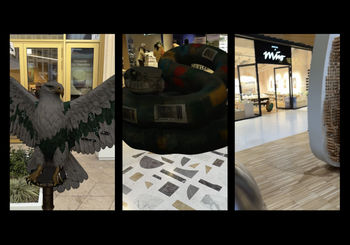
Three examples of the interaction inside Waltherpark. The Eagle at Sturbucks, the Snake at Esselunga and the Hun at Hotel a Miio.
Space Ötzity


