Irrwege der Gesellschaft
Katharina Theresa Mayr
A removed cobblestone and a personal story – forming a narrative, leading to a social critique.
An encounter becomes the starting point.
A conversation, a life story, a profession rooted in laying stone by stone – creating paths within a given space. A space taken from the public, polished, rearranged, updated. Is it a new path, leading society towards new values?
The cobblestone becomes a token.
A material loaded with history, craftsmanship and invisible labour. Beneath the surface lies a precise system you cannot rush. Like the layers underneath, those who build these paths often disappear once the surface is completed and opened to the public.
Signs appear.
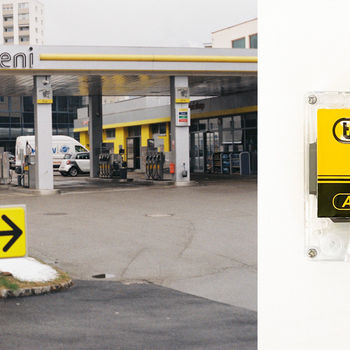
Signage as a system of orientation, instruction and control. The sign is the message, and the message has a function. Yet signs can mislead. Are we blindly following the directions imposed on us? Who decides where to go, and what is the “right” path?
The Steinmänner (Stoanerne Mandln) – stone cairns – enter the work as symbols of orientation. Originally built as navigational aids in rough terrain, they mark paths where no signs exist. Simple, clear, readable. If you follow one, the next reveals itself. But once displaced, repeated, aestheticised, their meaning shifts. What guides can also confuse.
The installation remains close to the ground.
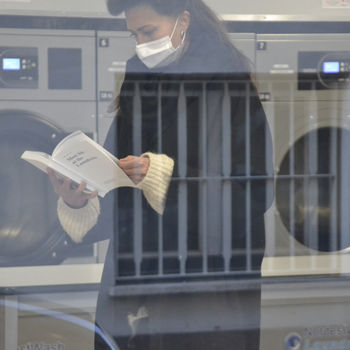
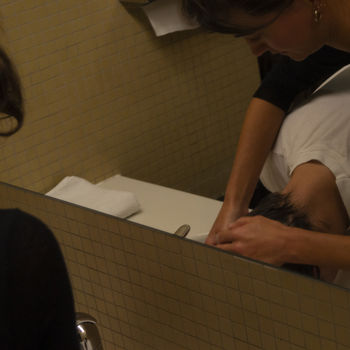
A frameless photograph leaning against the wall. A single stone printed with the title. At a distance, a stone cairn responds – in dialogue with the work, acting as an ambivalent wayfinder. Light, material and placement follow the logic of origin. Everything comes from below.
Irrwege der Gesellschaft uses familiar signs and materials to alter their meaning. A spatial gesture that maps social critique. Subtle, poetic – yet persistent in the eye of the beholder.


Space Ötzity