Wine line
Annalena Psenner
This innovative glassware concept for fine dining transforms the traditional wine glass form a passive tool into an active tool for sensory discovery. By isolating and enhancing specific sensory impressions, it guides the guest through a structured four-glass tasting sequence.
Based on the sommelier’s three pillars—appearance (Vista), aroma (Olfatto), and taste (Palato)—the wine always takes center stage. The menu acts as a supporting "+"—a reversal of the traditional roles, strictly designed to complement the wine's evolution. In practice, each glass is filled precisely to the 0.1-liter mark, where the glass’s refraction changes. The guest first tastes the wine on its own; only after it has been served do the corresponding dishes follow
The choreography unfolds in four phases:
Glass 1: Glowing Horizon (Vista I): Focuses on clarity and brilliance; paired with a sparkling wine and an antipasto.
Glass 2: Foggy Foundation (Vista II): Blurs physical details to highlight consistency, viscosity, and weight; paired with an oaked Chardonnay and a starter.
Glass 3: Veiled Identity (Olfatto): Vision is completely obscured to force the decoding of the wine through its bouquet; served with an orange wine and a deconstructed quiche.
Glass 4: Dark Introspection (Palato): Completely obscures the view for a taste-focused finale that emphasizes structure, temperature, and mouthfeel, it's almost a blind tasting glass; paired with a Riesling and a “mock-tomato” dessert.
Ultimately, this concept redefines wine enjoyment and perception through a truly multisensory experience.
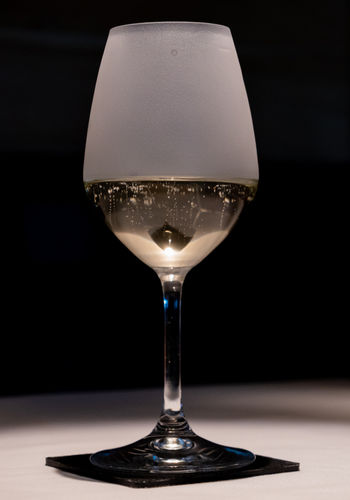
Glass 1: This glass acts like an optical zoom, radically directing the gaze toward the wine's purity, perlage, and subtle nuances of color. The design features a frosted upper section and a crystal-clear base. The sensory journey begins here with pure visual appreciation, making the wine instantly tangible.
Wine: Comitissa Lorenz Martini Pas Dosé 2020
Dish: A Parmesan taco filled with king oyster mushroom, finished with a touch of popping candy.
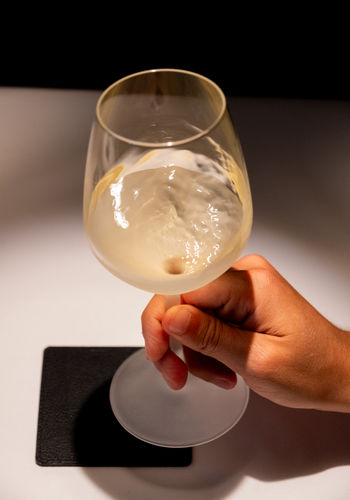
Glass 2: While the first glass reveals precise details, this glass veils the optics to redirect the focus entirely toward consistency. Featuring a frosted base and a crystal-clear upper section, it encourages the guest to concentrate on the texture and weight of the wine within the glass—a deeply physical encounter with its substance.
Wine: Chardonnay Riserva Baron Salvadori, Nals Margreid 2021
Dish: A multi-consistency exploration of porcini and polenta. A dish featuring a creamy, gelled polenta base, a viscous porcini mushroom confit, a poached quail egg with a liquid yolk, and caramelized hazelnut halves. The Chardonnay—with its signature, elegant viscosity—glides effortlessly through these contrasting textures, while the quail egg adds a luxurious mouthfeel.
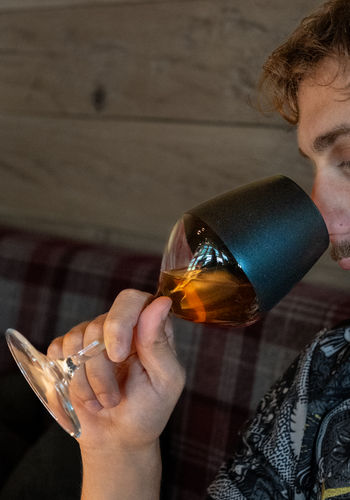
Glass 3: Through a deliberate optical distortion, all visual expectations are completely blocked out, leaving the sense of smell as the main protagonist. The guest must navigate the aroma blindly, decoding the wine’s identity purely through the nose. The design features an opaque black upper section and a crystal-clear base.
Wine: Vitalba Albana Romagna, Tre Monti 2023 (Amphora)
Dish: A deconstructed quiche featuring mild South Tyrolean sauerkraut atop a crispy shortcrust pastry sail, complemented by a matured mountain cheese foam and a caraway crumble.
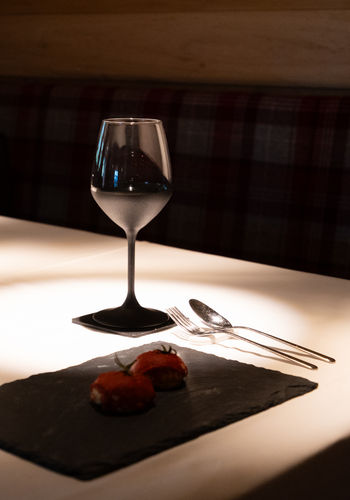
Glass 4: Operating as a complete blind-tasting tool, this glass leaves the guest with no visual reference. Only through interaction—such as tilting it to sip—does the shifting refraction briefly reveal the wine. By completely obscuring sight, it triggers an intense element of surprise, focusing all attention on structure, temperature, and mouthfeel without distraction.
Wine: Riesling Spätlese "Wehlener Sonnenuhr", Dr. Loosen 2010
Dish: A "mock tomato" encased in a glossy strawberry glaze, filled with a creamy white chocolate and mascarpone mousse with lime zest, complemented by a vibrant basil gel. The mature sweetness of the Riesling flourishes alongside the white chocolate, while the strawberry-basil notes trigger the wine's freshness.
Designing How Things Feel (Right) - Usability & Emotional Interaction in Physical Products