

Rainer
Andrea Ghirardi
Student
Andrea Ghirardi Academic staff
Camilo Ayala Garcia Klaus Hackl Ingrid Kofler Course
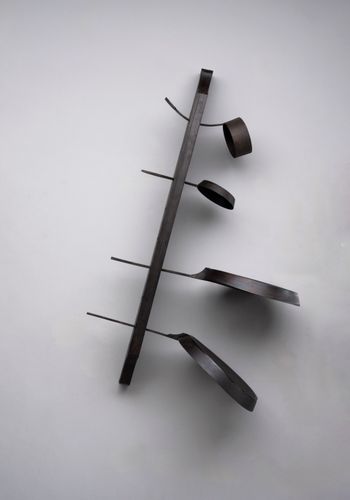
Products from Artefacts: Designing as Cultural Transmission. From a Tyrolean smoke kitchen, ca. 1800: a softwood plank, eight oblique cuts, iron pans held by gravity alone. No clip, no mechanism of any kind. No maker, no date. The dark patina is soot — decades of fire and invisible labour pressed into the wood.
Rainer inherits exactly that principle. An oak cube holds a conical glass filter above a square glass carafe. The cube provides only the height, the angle, and the space for the fall. Water pours through by gravity. No pump, no switch, no moving part.
The same logic, two centuries later. A slow, quiet ritual before the day begins.

1/4

2/4

3/4

4/4
A project made in the course
Products from Artefacts: Designing as Cultural Transmission.
During the Summer Semester 2026, we have been exploring product design as a cultural practice, examining how artisanal knowledge embedded in historical artefacts has been transmitted across generations and apprehended through careful observation, making, and use. The studio course has combined research-driven inquiry, hands-on experimentation, and material engagement, enabling students to connect insights into the evolution of object typologies with their own design practice. Our main focus has been on vernacular artefacts—traditional household items, rustic furniture, farming tools, and details of rural architecture—as found in open-air museums and folk-art collections across our alpine region. Crafted for daily use, these examples of anonymous design—many of remarkable beauty, ingenuity, and longevity—bear traces of adaptation and refinement, shaped by scarcity of resources, local conditions, and pre-industrial craft traditions.
Explore related projects

Nina Marie Malachin
Can you transform an artifact into a new object?

Samuele Mogno
How can reclaimed truck tarps be upcycled into a functional bag?

Chiara Cherubin
Shouldn't adults take a break too?

Liesa Marty
Can you sit comfortably in corners?

Franziska Fischer
What if change begins with a sound?

Virginia Dobos
What can a 19th-century farm tool teach us about designing modern furniture?