What happens when women ride together?

Degree Project

Biking is a collective superpower

Silvia Rafanelli

Cycling is often perceived as an open and accessible activity. Yet cycling culture has historically been shaped by norms of speed, competition, and performance that have not always made space for different bodies, experiences, and ways of riding.

Across Italy, however, new communities are emerging that challenge these dominant narratives. Women and FLINTA cyclists are creating alternative spaces within cycling culture spaces built on mutual support, collective presence, care, and shared exploration rather than competition.

Biking is a Collective Superpower explores these communities and the practices that connect them. Through this project, cycling is understood not only as a sport or a form of mobility, but also as a collective and political practice that can generate visibility, empowerment, and new ways of inhabiting public space.

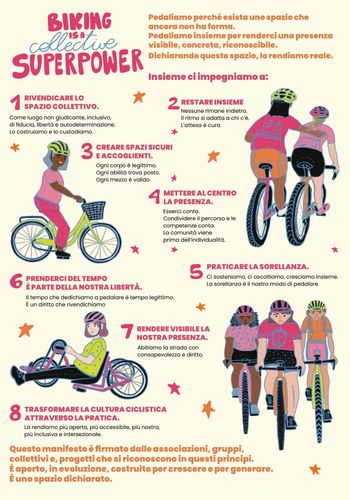
At the center of the project is the development of a feminist cycling manifesto, created together with cycling groups and collectives across Italy. The manifesto gathers shared values and practices that already exist within these communities and makes them visible as a collective statement.

More than a declaration, the manifesto becomes a tool to connect different initiatives and strengthen the growing network of women and FLINTA cycling communities.

The Research

The research process combined theoretical investigation with conversations and exchanges with people actively involved in these cycling communities.

To better understand how women and FLINTA riders experience cycling culture, I conducted a series of interviews with associations, collectives, and grassroots projects across Italy. These conversations explored questions of access, visibility, safety, and community-building in cycling.

Among the groups involved in the research are Bikeboobs (Borgo San Lorenzo), CC Pink (Piedmont), Vado e Basta (Pescara), Donne in Bicicletta e Micromobilità (Cagliari), Ragazze in Tandem (Florence and Milan), VaiGine (Milan), W Collective (Milan), and Gruppo del Mercoledì (Bassano del Grappa). Each of these communities practices cycling in different ways, yet they share common values such as inclusivity, collective support, and non-competitive riding.

The research also included a participatory workshop and a shared collaborative document, where participants were invited to reflect on their experiences and collectively articulate the principles that guide their practices. This process allowed the manifesto to emerge not as an individual statement, but as a shared reflection shaped by multiple voices. 
 

The Manifesto

The outcome of this process is a collective feminist cycling manifesto that articulates principles already present within these communities.

The manifesto addresses themes such as reclaiming collective space, practicing solidarity, creating inclusive environments, and making the presence of women and FLINTA cyclists visible in public space. It also challenges dominant cycling narratives by emphasizing care, shared pace, accessibility, and collective presence.

Rather than prescribing rules, the manifesto recognizes and amplifies existing practices that are already transforming cycling culture from within.

Alongside the manifesto, the project also maps the network of associations, collectives, and projects that contributed to this process, highlighting the diversity of initiatives working to create more inclusive cycling environments. 


One of the most meaningful aspects of this project was the dialogical nature of the research process. Conversations with cyclists, organizers, and activists made visible how many of these practices already exist but often remain under-recognized within mainstream cycling culture.

At the same time, the project acknowledges its own limitations. The manifesto is not intended as a definitive statement, but rather as an open and evolving framework that can continue to grow as more communities contribute their perspectives.

Looking ahead, the manifesto can function as a shared reference point for groups that recognize themselves in these values. By connecting different initiatives and making their practices visible, the project hopes to support a broader cultural shift toward a more inclusive and collective cycling culture.

Ultimately, Biking is a Collective Superpower highlights how cycling, when practiced together, can become a powerful tool for building community, reclaiming space, and imagining new ways of moving through the world. 

The manifesto represents a starting point rather than a final outcome. Future developments of the project aim to strengthen the connections between the groups involved and expand the network of women and FLINTA cycling communities.

1/5
2/5
3/5
4/5
5/5
A project made in the course

Master in Eco Social Design Laurea / Abschluss 26.1

Graduation projects from the Master in Eco-Social Design.
More projects by Silvia Rafanelli