How can eco-social designers support the start of a material depot?

Aufwind

Lisa-Marie Halwax
Franziska Muncz
Julia Caroline Silvia Ute Tebbe
Liselotte Michelle Van Beveren

"Aufwind" envisions the creation of a thriving material depot at BASIS in Schlanders (Vinschgau) — a space where post-consumer materials can be collected, shared, and creatively reused by the inhabitants and local craftspeople. The depot is both a warehouse for leftover objects and a starting point for a more circular and connected way of living: where waste becomes a resource, and citizens become co-creators.

We began by listening and mapping needs: A public survey and a material flow map helped uncover local needs, resources, and potential collaborators. To activate the space, we organized a series of interventions: from building furniture out of reclaimed doors and painting walls, to running a hands-on workshop during the denk.mal Festival: visitors created windmills and contributed design ideas for the façade, which were projected on the wall later in the evening – bringing the depot to life. A follow-up participatory workshop with local stakeholders explored future visions and concrete next steps. The depot is now growing – and you're invited to be part of it!

Students: Julia Tebbe, Liselotte van Beveren, Franziska Muncz, Lisa-Marie Halwax

Partner: BASIS

Supporter: Anna Hilber, Michael Schuster, Isolde Veith, Hannes Goetsch, Katrin Gruber, Paul Kofler 

Video link: https://youtu.be/6hzuO8OXDXU

Context and aim

The project is situated in Schlanders (Vinschgau), at the old, abandoned smith building located at the entrance to BASIS. Currently, it remains unclear which organization will manage the material depot, although several stakeholders are involved. Our primary contact has been Isolde, who is presently managing the initiative independently. Our role was to assist in organizing the space and supporting the initial setup of the depot.

The main goal is to establish a material depot. This project is in its early stages, involving practical tasks such as renovating the building. The overarching goal is to activate both the material depot and the local community. This aim was further divided into sub-goals:

- Closing material loops

- Raising awareness

- Promoting the depot

- Preparing the space

- Identifying community needs

The project was named Aufwind to symbolize the revitalization of the space and its activation.

1/1

Finding out needs

The project began by assessing the needs of local residents in Schlanders through a market intervention using a cargo bike transformed into an interactive survey station. The cargo bike displayed representative materials envisioned for the depot. Participants were surveyed regarding their possession and interest in second-hand items. Notably, many respondents associated second-hand goods primarily with clothing.

The findings indicated a community interest in a material depot with various items such as buttons, paper scraps, and second-hand hardware. 

1/4
2/4
3/4
4/4

Building up the space

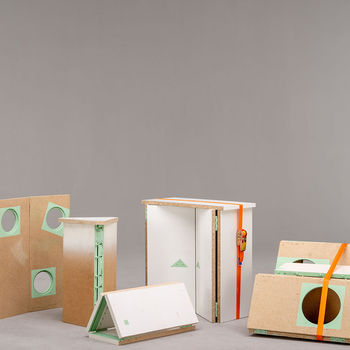
Simultaneously, physical improvements to the building were undertaken: demolition of an old chimney, repairs to walls and windows, exterior painting, interior cleaning, and furniture construction. For example, a table repurposed from an old door was crafted for use in workshops. Two large triangular-shaped structures, made out of old window frames were built to serve as co-design stations during the Denk.Mal festival.

Although work remains, the space now provides a clean, functional foundation for future renovations. Planned next steps include electrical installation, exterior mural painting, window installation, and addition of further furniture.

1/6
2/6
3/6
4/6
5/6
6/6

Promoting the space

During the Denk.Mal festival we promoted the material depot through multiple interventions. The main interventions was focused on a workshop about crafting windmills from recycled materials, like tetra packs, riso print scraps and old banners. The windmill symbolized material flow, closed loops, and change, resonating with the windy environment of Schlanders. The workshop attracted many children, and so, their parents, enabling valuable conversations about the material depot.

Additional activities featured an explanatory video on depot operations and materials, a material flow mapping to visualize local circulating materials and a co-design station on the triangular shaped structure about the design of the outside of the material depot. Later, in the evening, we projected those designs on the building. The festival proved to be an effective place to engage and promote the material depot with the locals.

1/14
2/14
3/14
4/14
5/14
6/14
7/14
8/14
9/14
10/14
11/14
12/14
13/14
14/14

Stakeholder workshop

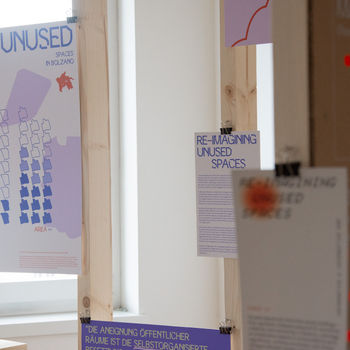
Towards the end of the project, a participatory backcasting workshop was organized. Various stakeholders collaboratively envisioned the depot's status in five years and identified necessary steps to realize this vision. This fostered stakeholder collaboration, created a support network for Isolde, and laid groundwork for the depot's sustainable operation.
1/7
2/7
3/7
4/7
5/7
6/7
7/7

Research and theoretical underpinnings

We conducted an assets and needs mapping (Palmieri, 2024) in the form of a material flow map to understand the types and movement of materials in Schlanders. This qualitative research is particularly suited for early-stage, human-centered design processes, where the aim is to reveal patterns, meanings, and relationships that can inform the shaping of a community-driven initiative. As such, our work aligns with design research traditions that prioritize co-creation, situated knowledge, and social complexity over abstract generalization (Sanders and Stappers, 2008).

The results showed that private individuals are the primary participants, indicating the depot will likely begin as a community-led initiative. This process fostered dialogue, co-creation, and ownership around material reuse. However, challenges remain, such as establishing clear guidelines for acceptable materials and strengthening institutional partnerships to support the depot's future development.

Backcasting provided a structured overview of challenges and solutions, reinforcing stakeholder cooperation.
1/3
2/3
3/3

Critical reflection and outlook

The project's hands-on nature was highly motivating, combining practical renovation with community interaction. However, the unclear organizational responsibility for the depot complicated promotion and planning. Institutional and political factors currently pause progress, pending clarification of management, operational details, material flows, and workshop programming. The stakeholder workshop created valuable offers of assistance in areas such as mural creation, material sorting, and staffing.
Our team integrated well into the setting, acknowledging its possibilities and limitations. With our diverse range of skills spanning craftsmanship, product and graphic design, and moderation, we successfully worked towards the aims we set ourselves at the beginning of this project. Overall, the project successfully activated the space, engaged the community, and initiated stakeholder collaboration, creating a strong foundation for continued development.

Palmieri, T., 2024. Context Mapping [Lecture + Workshop]. Design Research, presented on 16 October 2024.

Sanders, E.B.-N. and Stappers, P.J., 2008. Co-creation and the new landscapes of design. Design Studies.

A project made in the course

Project 2 - HOPE – 11 projects reclaiming the future now

In times with no reason for optimism, 11 projects »start [...] not from fear and enclosure, but from hope and overflowing.« (John Holloway). They are engaging for humble changes within a ~ hopefully ~ bigger emancipatory transformation, together with partners in the “real world”.  The projects range from circular material flows to repair, from reclaiming inclusive common spaces in the city to redesigning a school yard with the kids, from unheard stories of mountain ecosystems to sustainable tourism, from collective approaches to climate crisis to digital protest.
More projects by Franziska Muncz, Julia Caroline Silvia Ute Tebbe, Lisa-Marie Halwax, Liselotte Michelle Van Beveren
Explore related projects