How can we create an inclusive community space for all?

ARBO SIBERIA – Creating an inclusive community space

Greta Cazzanelli
Clara Dolder
Linda Enrich
Lilly Therese Tietze

ARBO SIBERIA is an ongoing project to transform a hidden, unused area of Bolzano into an open and inclusive space. It is a project of A place to B(z) — a growing movement to reactivate underused urban areas and create space for independent culture, bottom-up initiatives, and community-driven placemaking. Across Bolzano and many other cities, public and non-commercial spaces are becoming rare. Thereby, often those who don’t conform to the norm are pushed out. ARBO SIBERIA reclaims space as a creative and political act, upholding the Right to the City, especially for marginalised and invisibilised people. Building on input gathered during interviews and workshops, we developed a shared vision, a code of conduct, and a visual and organisational identity to guide the project’s future. Additionally, in a series of Flashmobs we highlighted the importance of places where you don’t need to consume in order to belong — spaces for all. 

Partner: A place to b(z) 

Supporter: Dormizil, Vinzi Verein, Bozen Fiorisce, Climate Action South Tyrol, Jugenddienst Bozen, Filmclub Bozen, PlatzProjekt, Kiosk of Solidarity, Bolzano Solidale, Zoona/Afzack.

Context and aims

ARBO SIBERIA wants to transform an underused area in the northeast of Bolzano (Bozner Boden/Piani) owned by RFI (Rete Ferroviaria Italiana) into an inclusive space for all. Due to Privatization, surveillance, and exclusionary policies public and non-commercial spaces are becoming rare in Bolzano. Our project responds to this situation by reclaiming space as both a physical and symbolic act, upholding the right to the city, especially for marginalised and invisibilised people. 

ARBO SIBERIA is developed together with and for the local community, including the neighborhood, current users of the site, the municipality, and various cultural and social collectives. From the beginning, we reached out to local groups working in fields such as homelessness support, youth work, art, music, and cultural production to understand needs and build connections.

The overall vision is to create an open, inclusive community space. A space that is free to use for everyone, with the aim to integrate current users of the space. A space with a place for social inclusion and solidarity, especially for marginalized groups. A space where you don’t need to consume in order to belong. A space for all.


Process and outcomes

When we first explored the hidden area behind Bolzano’s train station, we realised that people were living there. This moment became a turning point. We decided not to create a community project that would ignore or push aside the most vulnerable—in that case homeless individuals—but instead to design an inclusive process that integrates their needs. We didn’t want to contribute to further gentrification, we wanted to explore how to reclaim space without exclusion.

To better understand the situation, we reached out to local social organisations. Through interviews, we gained valuable insights into the challenges people experiencing homelessness in Bolzano. A key theme emerged: loneliness which led us to shift our focus toward social isolation and inclusion as the core of our project.

Around the same time, the municipality introduced a controversial ordinance banning sitting or lying on public ground. In response, we organised three flashmobs titled  “Hinsetzen.Hinlegen.Dableiben.”— peaceful protests and part of a broader “Right to the City” campaign that sparked a local debate. Our message was clear: everyone has the right to be visible, present, and active in their city.

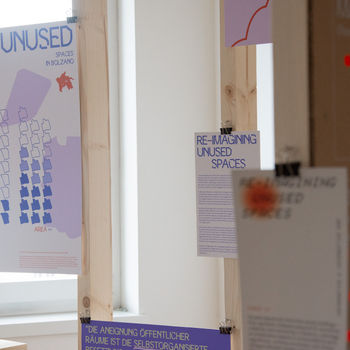
Beyond the flashmobs, our campaign—presented at the GOG semester exhibition—aims to raise awareness around the Right to the City and how A place to B(z) brings these rights to life by focusing on individuals, unused urban space, and marginalised communities. 

As part of this process, we developed a new visual identity and name for the area behind the train station: ARBO SIBERIA. "ARBO" refers to Areal Bolzano, while "Siberia" is the local nickname for this cold, shaded part of Bozen’s industrial east. The name reflects both the location and its social memory—transforming a neglected space into one full of potential. To make this vision tangible, we conducted several interviews with institutions, experts, and people active in the field. In a participatory workshop, we invited diverse collectives and community members to imagine together what such a space could be, - we co-created a Code of Conduct, discussed infrastructure, and mapped out ways of organising events and sharing responsibilities.

After months of fieldwork and collaboration, we decided to share our learnings in a booklet:"How to reclaim Bolzano”. It offers guidance on how to create an aware and inclusive community space, combining practical tools, stories, and insights rooted in Bolzano’s urban realities—exactly the kind of knowledge we wish we had from the start.

1/10
2/10
3/10
4/10
5/10
6/10
7/10
8/10
9/10
10/10

Research and theoretical underpinnings

We began our research with a visit to the area in March 2025. Using the method of “Urban Design Thinking” from the book "Stadt selber machen", we started to observe and map the site. This tool helped us recognize that the space is not empty—it is already being used, mostly by homeless people. This insight became the foundation of our approach. From there on we went to the site regularly and began writing our observations in a collective notebook. 

From our interviews with local organizations such as Dormizil, Vinzi Verein, and Bozen Solidale we learned that some of the most important needs are very basic: places to sit, access to clean water, toilets, washing facilities, and maybe even a community kitchen (Küfa). Lockers on-site were also mentioned as helpful. Also a central theme quickly emerged: many people—whether homeless, elderly, young, or otherwise marginalized—struggle with feelings of loneliness. Data from the ASTAT Youth Study 2021 in South Tyrol shows that 13% of young people aged 14 to 25 reported feeling lonely often. That’s a sharp rise from just 8% in 2016—an increase of over 60% in five years. These insights led us to ask new questions: How can we create a space that includes people with different backgrounds and needs? And what kind of infrastructure and organization would make such a place possible?

To find answers, we collected a series of case studies from different fields that we see relevant for this area. These include community gardens, playgrounds, workshops, containers as sleeping pods or exhibition spaces, and kitchen areas. We were especially inspired by places where people can stay without needing to consume—spaces that feel welcoming.

To better understand some placemaking-projects that seemed to have a similar structure, we did two more interviews—one with "PlatzProjekt" in Hannover and one with the "Kiosk of Solidarity" in Berlin. "PlatzProjekt" is a shared space in Hannover where people can try out ideas, start small projects, or work together. It supports creative, social, and community-based activities in a flexible, open environment. The "Kiosk of Solidarity" in Berlin is a format that intervenes in the fields of works, health and housing in Berlin. Neighbours and other interested parties can temporarily bring their practice into the public space using the kiosk. 

We also organized two workshops. The first one was a small-scale session with people who work with homelessness. We talked about daily needs and their utopian wish for the future of the area. The second workshop brought together people from cultural, youth, and social work backgrounds. Using a combination of the Future Workshop and World Café methods, we worked together to define shared values, draft a code of conduct, and brainstorm ideas for organising and activating the space. These participatory moments helped shape our understanding of what the space could become.


1/3
2/3
3/3

Critical reflection and outlook

The project successfully brought together diverse actors, elevated public awareness, and laid a solid foundation for the reactivation of the space behind the train station. Our flashmob campaign proved effective in generating visibility and sparking dialogue around the use of public space and the Right to the City, especially during a politically sensitive time of municipal transition. The participatory workshops fostered a sense of shared ownership and demonstrated the demand for a low-threshold, consumption-free cultural space.

While direct contact with homeless individuals proved challenging, the topic remains important to us, and we aim to include inclusive infrastructures – such as lockers and access to clean water – in ARBO SIBERIA  to support their everyday needs.

However, structural challenges persist. The municipal bando for the area’s use has yet to be published, leaving the legal status unresolved. Without a formal agreement, questions around responsibility, liability, and long-term management remain. Strategic planning is essential to build resilience and sustainability.

If the bando is released as promised, ARBO SIBERIA could become reality by autumn. This would mark the beginning of a crucial new phase: organising necessary infrastructure works, hosting collaborative building sessions, and preparing for a public opening of the site. Key tasks include assigning official responsibility, determining paid roles, and establishing a reliable volunteer system. These structures are crucial for smooth and inclusive operations. 

A stable financial base is equally important. Wages, artist fees, utilities, and material costs must be secured to ensure the space does not rely solely on unpaid labor or sporadic support. Sustainability will depend on a mix of institutional support, creative funding, and community involvement.

Meanwhile, new partnerships are also evolving. Talks with Afzack, a local cultural association, are underway, and an initial exchange with Zoona, a like-minded initiative, has taken place to explore future collaboration. These alliances expand the project’s reach and reinforce momentum for citizen-led transformation.

Despite the uncertainty, the energy around ARBO SIBERIA remains strong. A community dinner in June 2025 will serve as a next step—reconnecting with interested people, updating on what is happening at the moment, and reaffirming the values of care, accessibility, and co-creation.

Ultimately, the project aspires to become more than a space: a living example of inclusive urban futures, shaped not by top-down planning, but by solidarity, imagination, and grassroots collaboration.


A project made in the course

Project 2 - HOPE – 11 projects reclaiming the future now

In times with no reason for optimism, 11 projects »start [...] not from fear and enclosure, but from hope and overflowing.« (John Holloway). They are engaging for humble changes within a ~ hopefully ~ bigger emancipatory transformation, together with partners in the “real world”.  The projects range from circular material flows to repair, from reclaiming inclusive common spaces in the city to redesigning a school yard with the kids, from unheard stories of mountain ecosystems to sustainable tourism, from collective approaches to climate crisis to digital protest.
More projects by Clara Dolder, Greta Cazzanelli, Lilly Therese Tietze, Linda Enrich
Explore related projects