How to contribute to a regenerative tourism in Lagarina Valley?

Rituale Sylvestro

Alice Peruzzo
Isolde Vadala

The community academy, La Foresta, is structuring the tourist experiences within the NEB (New European Bauhaus) frameworks, which enables the green transition of our societies and economy through tangible experiences at the local level. To begin with, the project wants to reverse the dynamics of extractive tourism, which branches out in different ways and contexts. From the pollution of places of interest, and the extraction of resources to the lack of reciprocity as the basis of the relationship between the context and tourists. To do so, the fabric is a reflective artifact highlighting the importance of establishing a balance between consumption and parsimony. For this reason, four guidelines will be visible, (inspired by the book “Braiding Sweetgrass”, R.W. Kimmerer: 2013): “Introducing, Asking permission, Taking and giving, Being thankful”, whose aim is to foster reflections about the way we approach places and their sources through inputs and exercises. 

context and aims

The key orientation of the COOLTOURS project is to review tourism through cultural renewal and environmental protection in the ALPE-ADRIA area (to which also Lagarina Valley belongs), as key principles. In doing so, the predominant narrative related to the tourism sector and the structure of the experiences offered (starting from what tourism agencies promote, with experience packages) should be reviewed. 

La Foresta is an association that operates in the context of Vallagarina, producing a positive impact on the territory and creating a space focused on co-working, social inclusion, mental health, and bringing attention to important aspects, such as environmental justice and sustainability. Defined as ‘hit-and-run’ tourism, Vallagarina is not seen as a destination to be reached, but rather as a place to pass through, halfway between Trento and Riva del Garda. Those who decide to linger nearby will end up in the city, and few are the outsiders who decide to discover the entire valley beyond the city. Even the inhabitants themselves. In this sense, the aim of the project is to foster a connection between people and the Lagarina Valley. The project is part of a European framework (NEB); however, to be more specific, what is the NEB Compass, and what role does it play within the project setting? As a matter of fact, it is an index that makes it possible to set, change, and modify any related projects without losing the compass. There are three important parameters: Beauty, as creating meaningful collective perspectives and experiences. Together, as equal access to opportunities and resources. Sustainable, as prioritizing the co-living of human and non-human elements. 

This is how the 5 prototypes, or proposals were born. Each one of them with different themes, contexts, objectives, and recipients. Each one seeks to establish a local multi-species relationship, to probe common principles linked to the traditional use of the land through artistic practices, and to use the principle of alpine community economies as practices of care, place, people, and species.  The recipients of these experience packages, or prototypes, are defined by a new noun, ‘cooltourist’. They are people who want to be part of a biodynamic system, where the heterogeneity of the participants is the added value to live an authentic experience. Moreover, they can continue to know and learn, going beyond the traditional circuits.

process and outcomes

Within the semester, the process started taking into account the five different prototypes developed by La Foresta. First of all, one of these was the prototype called "Comunità Frizzante". The initial approach considered above all the roles of the senses during the exploration of new scenarios. The way the senses are involved when learning anew profoundly influences the mechanism of memorization. To start playing with these sensations, we wanted to test them with an excursion to Terragnolo, a municipality near Rovereto. After the experience, we were able to produce a personal herbarium made of a collection of postcards, showing the plants we foraged together. Each plant had a personal description (based on associations with memories, tastes, past experiences, textures, and smells), a “personal” name of the plant, and a symbol associated with the plant. The connection with each plant can be different for everyone, not only based on its use but also on what this plant is awakening in us. 

1/6
2/6
3/6
4/6
5/6
6/6

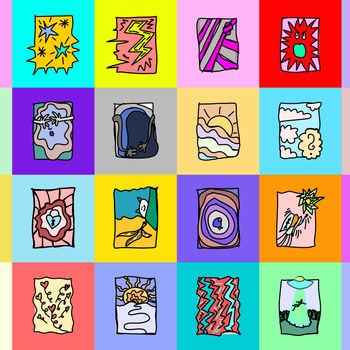
The second step was to prepare empty postcards, for the event "Fontane Frizzanti", to test it with external participants. The format itself allowed people to engage within the artifact, producing a personal description (going through specific questions about perceptions to process), finding a more personal name, and trying to translate all the inputs into forms, shapes, or symbols. Symbols have the power to visualize and metaphorize perceptions through memories, emotions, and associations. The connections created help the process of memorization, highlighting the stories hidden behind clichés, and the bond created while sensing the plant. 

1/7
2/7
3/7
4/7
5/7
6/7
7/7

Having reached this step, a more focused perceptual approach was sought to achieve the objective of the COOLTOUR project, namely to revise the tourism plan for the area. To be able to do this, it was necessary to start from the base and investigate: every experience recalls an object to be taken away as a souvenir of the place visited. This take has consolidated the basis that tourist packages are organized by experiences and related objects that can be purchased as souvenirs, rather than by the desire to know and connect with the place. However, is it possible to start giving something back, instead of taking from places and people? How should we establish contact with what is surrounding us? 

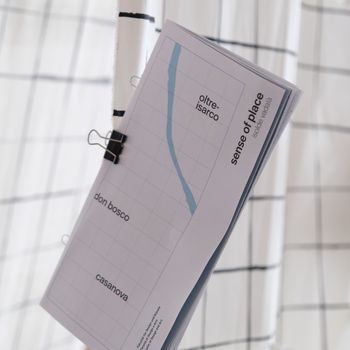
In the first place, defining guidelines, or “rules” to follow as a way of interacting in an unknown environment (“introducing”, “asking permission”, “taking and giving” and finally “being thankful”). This set of 4 guidelines inspired by the book Braiding Sweetgrass (R. W. Kimmerer: 2013) establishes 4 specific exercises that are not linked to each other. Each exercise will have incipits that support but do not define the guideline itself. The strength of this expedient lies in its adaptability to each context, considering even a short timeframe before, during, or at the end of each prototype. The use of textiles makes the experience adaptable in external contexts and favours a more prolonged use over time, compared to paper. At the same time, it becomes a practical material for establishing relationships because of its modular form and the possibility of adding elements (sewn, printed, coloured) without losing meaning. 

1/4
2/4
3/4
4/4

research and theoretical underpinnings

The initial questions that drove the research process in Lagarina Valley’s touristic portrayal were: Which is the predominant narration? How does it shape the context? Which aspects of the Lagarina Valley are considered worthwhile for the touristic offer and which are not? In terms of understanding on a personal level, it was decided to take brochures from the local tourist agency in Rovereto as a sample and undertake an itinerary there on the spot, improvising ourselves as day tourists. The experience allowed us to ask ourselves questions about the way tourism influences the area of interest and the relationship between the inhabitants and how they interact with the local area. 


In order to gain a better understanding of the local context, the Trentino Ethnographic Museum in San Michele all'Adige (METS) illustrates the agro-sylva-pastoral subsistence system of the Trentino valleys, the handicrafts that surround it, and the testimonies of art and devotion, music and folklore. A special area is dedicated to the image of the wild man (see exhibit Selvatico contemporaneo). This mystical figure still arouses conflicting emotions today. The so-called “Selvatico” represents a figure who lives almost in symbiosis with nature, not only taking from the woods what he needs but also preserving and passing on notions to humankind. What this figure tries to teach is that it is human to take something necessary (functional, edible, or beautiful) and put it aside, in a bag, to take it home with you. It is an action that is done repeatedly, sometimes it becomes part of an unconscious process to which you give meaning later. The function can be decided by the person, who can eat it, share it, show it, or find a use for it. To hold something in your hands is to create a bond with it, while to use it is to carry out this bond with a solemn ceremony (see The Carrier Bag Theory). 

This image contrasts the exploitative approach that characterized tourism and our society through a search for gimmicks that acquire value for a short time, the time to experience them right there. Knowing the point of view of the inhabitants, at this point, was necessary to continue. Thus far, we analyzed this by considering one of the fields that have been culturally characterizing Trentino lately, foraging. Both of the people interviewed (L. Speri, of Azienda Agricola “El Massarem”, and M. F. Massida, of “Maso Garten”) are experts in the field of local foraging and have farming-related activities. They questioned the fact that tourism is approached with recklessness and lack of respect: more emphasis is placed on proposing certain types of activities (like "letting the kids milk the goats"), rather than trying to understand the context through which everything takes shape.

1/5
2/5
3/5
4/5
5/5

So how to give justice to the visited landscape? One finds oneself in a place in which one does not know the dynamics behind it. In order to get to know them and give them the right value, one needs structures, and guides that can show what is not visible. They can work in the short and long term, at home or on holiday. These guidelines underline the importance of what we are taking and consuming “from both the physical and the metaphysical worlds” (see Braiding Sweetgrass).

The choice of using the fabric as a tool to establish relationships was made looking at the SOR project. SOR (Strategies of Relationality) stands for a self-organized, para-academic learning common. “Together, they investigated how to navigate contemporary political, economic, and ecological complexities in relationally meaningful ways. For this reason, they developed a screen-printed, hand-sewn, and square-shaped textile piece featuring a diverse selection of instructions. The flexibility of the fabric allows the piece to be utilized as either a wearable, a publication, or a container of some sort. It is in the hands and around the bodies of its users that it unfolds its contextual significance” (from the SOR website).

critical reflection and outlook

The project development process presented both stimulating opportunities and significant challenges. What worked most was a collaboration always punctuated by open exchange and shared reflection. The main difficulty was to find a meeting point between the partner's expectations and needs with those of a project rooted in a university context. These criticisms highlighted the need for compromise, finding common ground that could align every actor's needs, and strengthening the exchange of input and ideas. The process, moreover, expressed the need to return to a vision detached from what was developed by “La Foresta” until then. Greater emphasis has been instead placed on tourism, which emerged as the central focus of the project. This shift prompted a re-evaluation of the initial idea proposed during the first co-design meeting hosted by La Foresta, in which the “Comunità Frizzante” prototype was the one that we focused more on. Currently, the restitution set to create an artifact, while independent, could still contribute meaningfully to all the existing prototypes. Regarding the economic aspects, the project itself does not require much budget, considering also the opportunity of using leftover textiles.

As for future steps, there is still space for improvement. After a series of feedback sessions, with all the people involved in designing the prototypes, we received new inputs:

_ testing the cloth in different settings, to understand its strengths and criticalities (even considering the chance to develop it within the prototype itself)                                                                   

_ proposing the guidelines both in the Italian and English versions

_ developing a QR code, explaining the guidelines with some recordings (to make them more accessible)

_ making the sheet usable for multiple purposes (tablecloth, blanket, rain cover, tents, 

literature

_ Crowther G., Eating Culture, 2018, Canada, University of Toronto Press.

_ Kimmerer W. R., Braiding Sweetgrass, 2020, Great Britain, Penguin Books.

_ Le Guin K. U., The Carrier Bag Theory of Fiction, 2024, Cosmogenesis.

_ Pink S., Doing sensory ethnography, 2009, Los Angeles, California, SAGE.

_ Museo San Michele, Mets, Selvatico Contemporaneo, Museosanmichele.it, 2020, www.museosanmichele.it/selvatico-contemporaneo. Accessed 18 May 2025.

_ New European Bauhaus (NEB), https://new-europeanbauhaus.
europa.eu/index_en, 2025, Accessed 18 June 2025

_ SOR (STRATEGIES FOR RELATIONALITIES, https://strategiesofrelationality.com/, 2025, Accessed 18 June 2025

acknowledgement

Thanks to La Foresta, "Accademia di Comunità", for letting us explore Lagarina Valley with their guidance and expertise. With this opportunity, we were able to put ourselves in an unknown context and find an open and engaged partner. Thanks to the professors Seçil Uğur Yavuz, Kris Krois and Sónia Cabral Matos for the enriching support during the entire semester.

Supporters: Chiara Mura, Irene Manfrini, Flora Mammana, Sara Spitaleri, Sebastiano Moltrer, Carmen Gonzàlez Miranda (stationfortransformation).

Interviewees: Luigina Speri (El Massarem); Massimo Falqui Massida (Maso Garten).

A project made in the course

Project 2 - HOPE – 11 projects reclaiming the future now

In times with no reason for optimism, 11 projects »start [...] not from fear and enclosure, but from hope and overflowing.« (John Holloway). They are engaging for humble changes within a ~ hopefully ~ bigger emancipatory transformation, together with partners in the “real world”.  The projects range from circular material flows to repair, from reclaiming inclusive common spaces in the city to redesigning a school yard with the kids, from unheard stories of mountain ecosystems to sustainable tourism, from collective approaches to climate crisis to digital protest.
More projects by Alice Peruzzo, Isolde Vadala
Explore related projects