How can we make used Materials and Objects more desirable?

Pop-Up-REX

Konrad Ruben Freyer
Cemre Oeztuerk
Pietro Rista

A Pop-Up system built from Furniture Leftovers for hosting Community Activities about Overconsumption and Reuse


Stepping into one of REX’ warehouses, where they store their second-hand materials, furniture and household objects, can be quite an overwhelming experience. In just over four years since the project began, an astonishing number of solely donated items have accumulated, serving as a clear sign for today's extreme form of consumerism, overproduction, and trend-driven design culture. Therefore, our partnership with REX is rooted in the radical commitment to generate value and fulfill needs without using new resources.  


The core of our collaboration is the consciousness that being active at the end of our society’s material flow can’t be enough. Therefore, we tried to strengthen REX’ diverse services and came up with a pop-up system, to host awareness-raising activities that include citizens in a solution-oriented practice that goes beyond selling/buying. 

Context and Aims


REX is situated in the former military barracks “Schenoni-Kaserne” in Brixen-Bressanone, characterized by the presence of various other associations and institutions in the immediate surroundings, such as the voluntary seniors association “Helfende Hände”, an asylum seeker housing, a small workshop where support activities for children take place, and “Schenoni Urban Lab” - an new cooperative planning project for the quartier. REX currently operates in two large warehouses, mainly dedicated to storing and selling secondhand objects, furniture, and materials.

In just four years, REX accumulated an enormous amount of solely donated objects, enough to nearly fill their entire space. As a result, an urgent need to deal with the problems of storage and organization arose, but also the need to increase the flow of materials and second-hand objects, with the hope of eventually matching the amount of sold objects and materials with the amount that comes in. On these premises, the project started with the question of how to make materials and objects more visible and reachable

To better understand the context, we began by exploring REX and its surroundings, initially through several conversations with Julia Vontavon, the manager of REX, both online and on-site. Through these dialogues and visits, we came to understand the broader ecosystem around REX: its organizational structure, the people involved, its dynamics with the neighbors and the municipality, and the spatial challenges it faces. During these meetings, we often shared our values, visions, and desire for the project, fundamentally contributing to building a relationship of trust with REX and grounding the project on solid foundations.

1/4
2/4
3/4
4/4

Process and Outcomes


In the beginning of the process, we discussed three possible directions for the project; focusing on either social engagement, organizing/logistic or diverse services. Each of these approaches offered different potential, but also raised new questions about what REX truly needs and what kind of steps would be most meaningful. Before deciding on a project direction, we wanted to better understand the situation, because many aspects felt chaotic at first. We knew that jumping into action too quickly could lead to short-term or superficially designed “solutions”. Therefore we took time to engage more deeply with the context. Using analytical methods like stakeholder mapping and a backcasting workshop helped us to clarify what was truly needed and what kind of change was possible within the context of our collaboration.

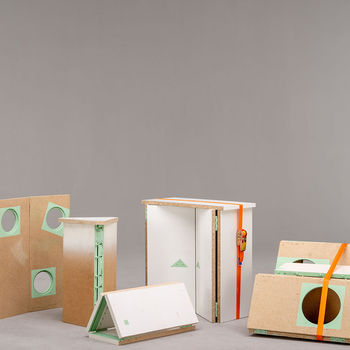
During the backcasting workshop, the concept of pop-up events emerged as a promising direction for REX. Together with Julia, we decided to pursue this idea, as we were intrigued by the potential for public interactions that showcase creative reuse of second-hand materials. With REX scheduled to participate in the ZUGLUFT FESTIVAL, we used this opportunity to design interactive stations specifically tailored for the event. Participating in the festival shaped both the design and application of our modular structures. We developed two interactive stations aimed at involving visitors in REX’s activities. The festival setting allowed us to test our system in the field and engage directly with people, actively including them in recycling activities. We arrived with two tables, each with a double tabletop—one at standard height for adults and one suitable for smaller children. One of them served as a work surface and the other as a playful sorting station for organizing screws and buttons by shape, color, and size. Additionally, we built a loom where participants could weave textile scraps, contributing to a collectively produced small carpet. We also constructed a shelf to complete the setup.

Since REX doesn’t own any transport vehicles, we designed the system to be lightweight and dismountable so it could also fit into a smaller car. All materials used to build the structures came from REX’s own inventory, primarily leftover furniture and materials that would otherwise remain unused. The system is compatible with standard panel materials such as chipboard or plywood. To keep the design open and accessible, we developed it for easy replication in any workshop equipped with a table saw.

1/10
2/10
3/10
4/10
5/10
6/10
7/10
8/10
9/10
10/10

Research and Theoretical Underpinnings


Stakeholder Mapping

Stakeholder mapping was the first step in our research with REX. We structured the map by combining two key dimensions: a temporal axis, representing past, present, and potential future stakeholders, and a scale of influence, showing the degree of impact each stakeholder has on REX and vice versa. We organized stakeholders into three main groups:

  • Core group: Direct contributors to the project who actively shape REX’s operations and are essential to its functioning.

  • Direct stakeholders: Individuals or organizations that either affect or are affected by the practices of the core group through direct collaboration.

  • Indirect stakeholders: Individuals or organizations who influence or are influenced by REX’s work without a formal relationship or direct exchange of material or immaterial goods.

The temporal dimension allowed us to explore how the degrees of influence have evolved over time, to visualize current connections and ongoing collaborations and how they might develop in the future.  We initially created the stakeholder map ourselves, and later reviewed it with Julia, the manager of REX. This review was particularly valuable in uncovering additional aspects of REX’s external relationships, as well as its aspirations for future growth and network. Based on these insights, we decided to visualize potential and desired changes in the map by drawing lines that project stakeholders from one area of the chart to another, indicating possible shifts in influence or engagement.

1/1

Backcasting Workshop

Building on the stakeholder mapping, we recognized the need for a deeper analysis of REX’s complex ecosystem. To address this, we applied a participatory strategic planning tool known as the Backcasting Method. This method begins by envisioning a desirable future and then works backward to identify the steps needed to reach that future.

We conducted a workshop using this method with six participants: one volunteer, two employees, and three members of the association. The process was divided into four key steps: strategic problem orientation, future visioning. analysis of the envisioned future, creating a path toward that future. Each step built upon the previous one, guiding participants from analyzing the current situation to developing a shared agenda for action. The workshop also served as a way to involve people actively as part of REX in shaping the project and to integrate their perspectives into its outcomes.

Our intention was to return the completed canvases from the workshop to REX so they could be revisited and discussed during the association’s regular meetings. At the same time, the results offered us a clear direction for identifying a tangible outcome for our project. From the follow-up agenda that emerged during the workshop, we selected several ideas that were feasible within our semester-long timeframe. Together with Julia, we chose to develop one of these ideas further: the design of a pop-up infrastructure that REX can use to host activities when participating in fairs and public events.

1/8
2/8
3/8
4/8
5/8
6/8
7/8
8/8

Critical Reflection and Outlook


First, it has to be pointed out that we feel very fortunate to have collaborated with Julia Vontavon, who supported us throughout the entire process, was quick to coordinate meetings, and showed genuine interest in the project’s development. Within our own team, a good balance of skills and motivations created a strong commitment to creating meaningful contributions to REX. We aligned well with their core ideals and saw the value of their practice but also brought a fresh outside perspective, which enabled us to take a more objective and critical look at the activity.

To discover how we could bring unique value to the project, we made use of the participatory design methods mentioned in the chapters above to identify meaningful focus areas. It was our first experience hosting such workshops, so we faced a lot of uncertainty that came with the little prior experience we had. Therefore, we had to invest substantial time and energy in researching and preparing for the unfamiliar approach. Luckily it paid off by forming a strong foundation for the tangible project outcomes that followed. This phase also resulted in significant personal and professional learning.

Because of our in-depth research phase, our design decisions were rarely arbitrary. They emerged from a detailed contextual analysis, which felt simultaneously constraining and guiding us. One drawback of this method was the significant time investment, which left us with four weeks for the design and manufacturing phase. Nevertheless, we succeeded in developing and building tangible outcomes within a tight time schedule. This was only possible due to the preexisting craft skills within our team, our access to the UNIBZ workshops and the support of the generous seniors at “Helfende Hände” who allowed us to use their workshop next door to Rex. Because of this, we were able to conclude the project in time for the Zugluft Festival where our pop-up system was then presented and tested for the first time.

A possible next step in the close future is a short workshop for REX employees on how to build the pop-up modules. This would enable them to reproduce and adapt the structures for future events. Since we followed an open and accessible design approach, a two-hour session is enough to fully understand the “Pop-Up REX” system.

A project made in the course

Project 2 - HOPE – 11 projects reclaiming the future now

In times with no reason for optimism, 11 projects »start [...] not from fear and enclosure, but from hope and overflowing.« (John Holloway). They are engaging for humble changes within a ~ hopefully ~ bigger emancipatory transformation, together with partners in the “real world”.  The projects range from circular material flows to repair, from reclaiming inclusive common spaces in the city to redesigning a school yard with the kids, from unheard stories of mountain ecosystems to sustainable tourism, from collective approaches to climate crisis to digital protest.
More projects by Cemre Oeztuerk, Konrad Ruben Freyer, Pietro Rista
Explore related projects