

Levitas’ Utopia as Method provided a crucial theoretical foundation. As she frames it as a methodological practice, a way of analysing the present, critiquing its limitations, and imagining alternative futures.
Talk the Walk
Carlota Coutinho Coelho Da Silva Portela Sophie Louise Meyer Adriana Maria Sotomayor Espinoza
Student
Carlota Coutinho Coelho Da Silva Portela Sophie Louise Meyer Adriana Maria Sotomayor Espinoza Academic staff
Teresa Palmieri Jacopo Ammendola Sonia Cabral Matos Mustapha El Moussaoui Course
Bolzano Open City Laboratory Program
MA Eco-Social Design Semester
2025/26 WS This project aims to reclaim public spaces in the city of Bolzano for women who frequently navigate it. To do so it is crucial to understand how women use public spaces and how they feel when doing so.
Is the city designed for all of them?
Were their needs taken into consideration when designing the infrastructure, services, and mobility?
What is the role of women inhabiting Bolzano in all this?
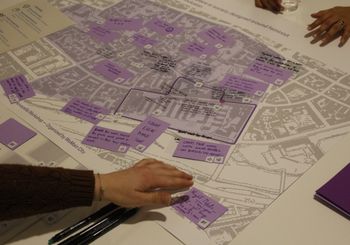
With the support of a toolkit that aims to empower women through exploration, sensorial mapping, and discussion prompts, we engaged in a collaborative discussion about a femtopian Bolzano, drawing from shared critical knowledge gained from their own lived experiences.
Bolzano is not particularly perceived as unsafe, but between male and female identified inhabitants, the latter have a lower perception of safety of the territory, as stated in the province’s very first report of safety perception conducted in October (Autonomous Province of Bolzano, 2025). We wondered how much of women’s perceptions are considered when designing or redesigning the city.
Perhaps the city does not feel unsafe, but there must be something that can improve the overall experience of navigating the city as a woman, reimagining it in ways that actively encourage women’s presence in all public spaces, making them visible, strengthening their role, and ensuring they can participate fully in urban life.
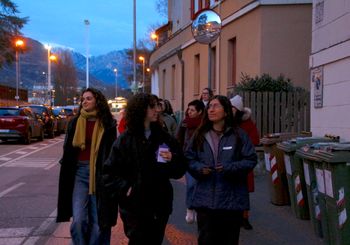
The exploratory walks were combined with a mapping exercise, translating these observations into spatial reflections and proposals for later going to the next step: creating the values for their femtopia.

1/3

2/3

3/3
A Femtopia is a blend of feminism and utopia an imagined neighbourhood designed around feminist values such as equality, care, safety and inclusion.
With this in mind and by reflecting on these experiences, through exploration, sensorial mapping, and discussion prompts, we engage women in the collective creation of a femtopia of Bolzano’s neighbourhoods, where they imagine alternatives to its current state, so they can live, work, enjoy, love, and care in it with ease.
Our project positions itself as a niche yet meaningful first step toward urban intervention and change, developed specifically for Bolzano, where no comparable project currently exists. Working closely with a small neighbourhood community allowed us to test our methods in a concentrated setting, laying the groundwork for future scaling.
We envision making our workshop materials digitally accessible, sharing the results of our speculative mapping online to increase visibility.

1/7

2/7

3/7

4/7

5/7

6/7

7/7
A project made in the course
Bolzano Open City Laboratory
“The question of what kind of city we want cannot be divorced from the question of what kind of people we want to be, what kind of social relations we seek, what relations to nature we cherish, what style of life we desire, what aesthetic values we hold” (Harvey, 2012). Staring from these considerations, the course took the form of an “Open City Laboratory”. In the first phase of the course, we listened to and oriented ourselves towards what Bolzano has to offer and what it might need. Critically reflecting on our encounters with the city and its actors, we detected possible spaces for intervention and developed situated proposals for eco-social transformations in Bolzano.
More projects by Adriana Maria Sotomayor Espinoza, Carlota Coutinho Coelho Da Silva Portela, Sophie Louise Meyer

Adriana Maria Sotomayor Espinoza, Maddalena Sartori, Teresa Ronchin
The denser, the better?

Ana Belen Perez Gonzalez, Aparna Gomathi Nataraja Pandian, Carlota Coutinho Coelho Da Silva Portela, Dide Su Unluakin, Shreya Shrinivas Deshpande
How far does the queen go?

Anael Arthur, Aparna Gomathi Nataraja Pandian, Carlota Coutinho Coelho Da Silva Portela, Dide Su Unluakin
What if the key to escaping the room was to learn to ask for help?

David Vincent Schwarzfeld, Johanna Cepeda Hess, Luca Toscano, Sophie Louise Meyer, Wentao Lu
How could water reshape the way we gather, cool down, and co-create a city?
Explore related projects
David Vincent Schwarzfeld, Johanna Cepeda Hess, Luca Toscano, Sophie Louise Meyer, Wentao Lu
How could water reshape the way we gather, cool down, and co-create a city?

Anna Pitton, Beatrice Guerra, Elena Galvani, Tommaso Sottopietra
How can a park guide people with dementia toward autonomy and inclusion?

Piera Pagnacco
What's the destiny of historical monuments?

Piera Pagnacco
How to do a real opening for a virtual exhibition?

Piera Pagnacco
How do you really see?

David Vincent Schwarzfeld, Laura Kalser, Marieke Kathrin Schaefer, Tom Sälzer
How to cool down our cities?