Can a multi-layer participatory design process empower a school community?

The Coolyard Project

Alessandra Capuano
Luca Damiano Collignan
Ana Belen Perez Gonzalez
Louis Steinhauser

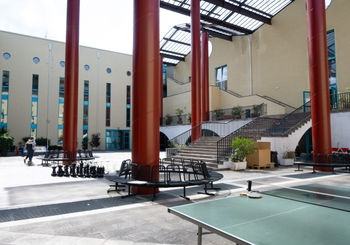
Coolyard is a participatory design project developed with the high school SozGym FoTour in Bolzano in collaboration with Eurac Research. Our aim was to engage the school community through a multi-layered co-design process that critically explored the school courtyard to identify its challenges and opportunities. Nature-based Solutions (NbS) were introduced as design tools to address both social and environmental issues to empower participants to actively shape their surroundings. The process generated a range of visual and conceptual outputs, which resulted in the design and prototyping of urban furniture interventions that reflect the collective ideas and aspirations of the school community.

The Coolyard Project

The desire to prepare the SozGym FoTour high school for a possible Nature-based Solutions (NbS) implementation project led to the need to raise awareness within the school community about environmental and social issues, while also fostering a sense of empowerment: the understanding that participation can help people take action and improve their own environment.

NbS, strategies based on the replication of natural mechanisms to mitigate the effects of climate change, played a central role in our process. They served both as a framework for critically observing the school courtyard and as a tool for designing concrete interventions.

We focused our activities on the school courtyard, an empty space that becomes too hot in summer and too cold in winter, where students spend more than one hour each day. Through a multi-layered participatory process lasting three months, we identified the courtyard’s challenges and opportunities and produced tangible outcomes to explore possible responses.

1. Research and Data Collection

Using a method inspired by Participatory Action Research, we developed two series of relational objects designed to better understand the school community, its habits, aspirations, and challenges through posters that encouraged different levels of participation. These posters allowed us not only to collect data, but also to assess the level and forms of participation that felt most natural and accessible within the school.

1/4
2/4
3/4
4/4

2. Data Interpretation

We conducted a thematic analysis of the outcomes and, to avoid relying solely on our own assumptions when interpreting the results, we organized a workshop with a small group of representative students who supported us during this phase. Based on this workshop and the subsequent analysis, we identified six concrete and widely shared social and environmental challenges related to the school courtyard.

1/6
2/6
3/6
4/6
5/6
6/6

3. Sharing Outcomes

To maintain the school community’s engagement and, at the same time, share the project's progress through continuous feedback, we collaborated with the small group of students who manage the school’s Instagram page. Their enthusiasm gave us the confidence to grant them a high degree of autonomy, and they documented the entire process using an appropriate tone and style.

4. Co-Design Workshop

The final event of this participatory process was a co-design workshop with 30 participants, including teachers, students, and other school staff. Through an activity inspired by the World Café model, we provided opportunities and prompts for participants to reflect on the six previously identified challenges, and we supplied a wide range of reused materials to produce models and sketches.

1/5
2/5
3/5
4/5
5/5

5. Prototypes

The final outcomes were a collection of models that served as both conceptual and formal inputs for the development of urban furniture prototypes.

On Monday, 8 June, we installed three urban furniture prototypes in the school. These were designed based on the formal and conceptual inputs that emerged from the models, and were funded through our partnership with Eurac.

1/5
2/5
3/5
4/5
5/5
A project made in the course

Project 2 - Welcome to Our Quartiere

In Project 2, student teams work with external partners on real-world, open-ended projects aimed at creating social-ecological benefits. Risk-taking is encouraged, and failure is treated as part of learning and creative practice. This semester, projects range from tools and methods for participatory urban and landscape design to initiatives promoting youth mental health and strategies addressing the current housing crisis.
More projects by Alessandra Capuano, Ana Belen Perez Gonzalez, Louis Steinhauser, Luca Damiano Collignan
Explore related projects